Not every emoji makes a message better—some can make the tone feel awkward, confusing, or unexpectedly funny.
The worst emoji is subjective because everyone interprets emojis differently. An emoji that feels harmless to one person may seem annoying, outdated, sarcastic, or uncomfortable to someone else. Context, relationships, culture, and platform design can all influence emoji meanings. That makes understanding the tone behind an emoji more useful than simply labeling one symbol as universally “bad.”
The worst emoji is often the one that makes your message mean something you never intended.
What Does “Worst Emoji” Mean?
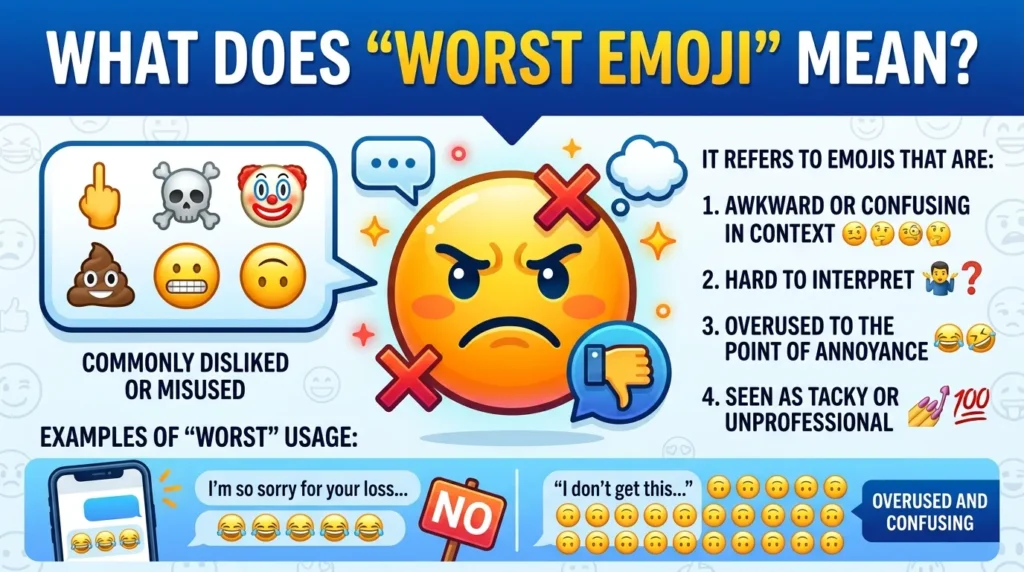
There is no official emoji ranking that identifies one symbol as the worst. Instead, people may call an emoji “worst” when they dislike its appearance, misunderstand its meaning, or find it awkward in certain conversations.
For example, 👍 can be a perfectly friendly acknowledgment, but some people may read it as brief or dismissive. Similarly, 🙃 can express humor or irony, yet its tone isn’t always obvious.
| Emoji | Common meaning | Sometimes misread as | Best used when |
|---|---|---|---|
| 😬 | Awkwardness or tension | Anger | An uncomfortable moment |
| 🙃 | Irony or sarcasm | Genuine happiness | Playful frustration |
| 😐 | Neutral reaction | Coldness | You have little reaction |
| 🤡 | Foolishness or self-mockery | Insult | Joking about mistakes |
| 👍 | Agreement or approval | Dismissiveness | Confirming something |
| 🙄 | Annoyance or disbelief | Hostility | Playful frustration |
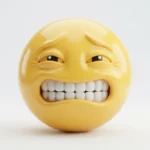
😬 Grimacing Face
Meaning: Awkwardness, nervousness, discomfort, or tension.
Example 1: That was a little awkward 😬
Example 2: I forgot what I was supposed to say 😬
🙃 Upside-Down Face
Meaning: Irony, playfulness, or a situation that feels absurd.
Example 1: Everything went perfectly 🙃
Example 2: Another unexpected problem 🙃
😐 Neutral Face
Meaning: A neutral, blank, or restrained reaction.
Example 1: I honestly don’t know what to say 😐
Example 2: That’s certainly one way to do it 😐
🤡 Clown Face
Meaning: Foolishness, silliness, or jokingly admitting a mistake.
Example 1: I really thought that would work 🤡
Example 2: Me trusting the plan again 🤡
👍 Thumbs Up
Meaning: Approval, agreement, or acknowledgment.
Example 1: Sounds good 👍
Example 2: I’ll be there 👍
🙄 Face with Rolling Eyes
Meaning: Annoyance, sarcasm, disbelief, or exasperation.
Example 1: Not this again 🙄
Example 2: You really said that 🙄
😏 Smirking Face
Meaning: A knowing, cheeky, smug, or teasing expression.
Example 1: I knew it 😏
Example 2: Maybe I already knew 😏
🫠 Melting Face
Meaning: Feeling overwhelmed, embarrassed, uncomfortable, or exhausted.
Example 1: Today has been a lot 🫠
Example 2: I need a break 🫠
😶 Face Without Mouth
Meaning: Silence, speechlessness, or having nothing to say.
Example 1: I have no words 😶
Example 2: That surprised me 😶
🤔 Thinking Face
Meaning: Thinking, questioning, or uncertainty.
Example 1: I’m not sure about that 🤔
Example 2: Let me think 🤔
How to Use the Worst Emoji the Right Way
On WhatsApp, potentially awkward emojis should be used according to the relationship and conversation. A familiar friend may understand 🙃 as humor, while someone unfamiliar with your texting style could interpret it literally.
On Instagram, emojis can influence the tone of comments and captions. A sarcastic emoji may make a joke obvious to some readers but sound rude to others.
On TikTok, emojis often work alongside humor, irony, and short-form reactions. Because comments are public, it’s worth considering how people outside your immediate circle might interpret them.
Do: Consider the message, audience, and relationship.
Do: Add words when the emoji could be ambiguous.
Don’t: Assume an emoji has exactly one interpretation.
Don’t: use an emoji to deliberately embarrass or insult someone.
Best Worst Emoji Combos — Copy & Paste
Awkward
- 👉 😬🙃 — An uncomfortable situation.
- 👉 😐😬 — A very awkward reaction.
- 👉 🤔😬 — Unsure what to say.
Funny
- 👉 🤡🙃 — Laughing at your own mistake.
- 👉 😬🤡 — A funny embarrassing moment.
- 👉 🫠🙃 — When everything goes unexpectedly wrong.
Sarcastic
- 👉 🙃🙄 — Playful disbelief.
- 👉 😏🙃 — A knowingly sarcastic reaction.
- 👉 😐🙃 — Dry humor.
Confused
- 👉 🤔😐 — Not understanding something.
- 👉 😶🤔 — Thinking without words.
- 👉 🫠🤔 — Overwhelmed and uncertain.
Awkward Replies
- 👉 👍😬 — A polite but uncomfortable acknowledgment.
- 👉 😐🙄 — Unimpressed reaction.
- 👉 😶🙃 — Having no response to an awkward situation.
Trending Worst Emoji Opinions in 2026
In 2026, opinions about “bad” or “worst” emojis remain highly subjective. Online users may criticize emojis because of how they look, how frequently they appear, or how easily their tone can be misunderstood.
Creators and casual users also sometimes use supposedly awkward emojis deliberately. That turns an unpopular-looking symbol into part of a joke, ironic caption, or exaggerated reaction.
| Emoji | Why people may dislike it | Common users | Platform |
| 😬 | Can feel awkward | Casual users | WhatsApp, TikTok |
| 🙃 | Tone can be unclear | Social media users | Instagram, TikTok |
| 👍 | May feel too brief | Everyday chatters | |
| 🙄 | Can sound dismissive | Casual users | Instagram, TikTok |
Emoji preferences continue to change as online communities develop new humor, slang, and communication styles.
FAQ
1. What is the worst emoji?
There is no universally agreed-upon worst emoji. Preferences depend on personal taste, context, culture, and how an emoji is interpreted.
2. Why do people dislike certain emojis?
People may dislike an emoji because of its design, overuse, awkward tone, or confusing interpretations. An emoji can also feel different across generations or online communities.
3. Is 👍 a rude emoji?
Usually, 👍 simply means agreement or acknowledgment. However, in some conversations it can feel abrupt, especially when someone expects a more detailed response.
4. Why do emojis look different on iPhone and Android?
Different platforms create their own artwork for standardized emoji characters. As a result, the same emoji can have noticeably different visual designs.
Calling an emoji the “worst” often says more about context and personal preference than the emoji itself.
Before using an emoji, think about how your recipient might interpret its tone, especially in short messages where there are few other clues.
When you’re unsure, a clear message paired with a simple emoji is usually the easiest way to avoid confusion.