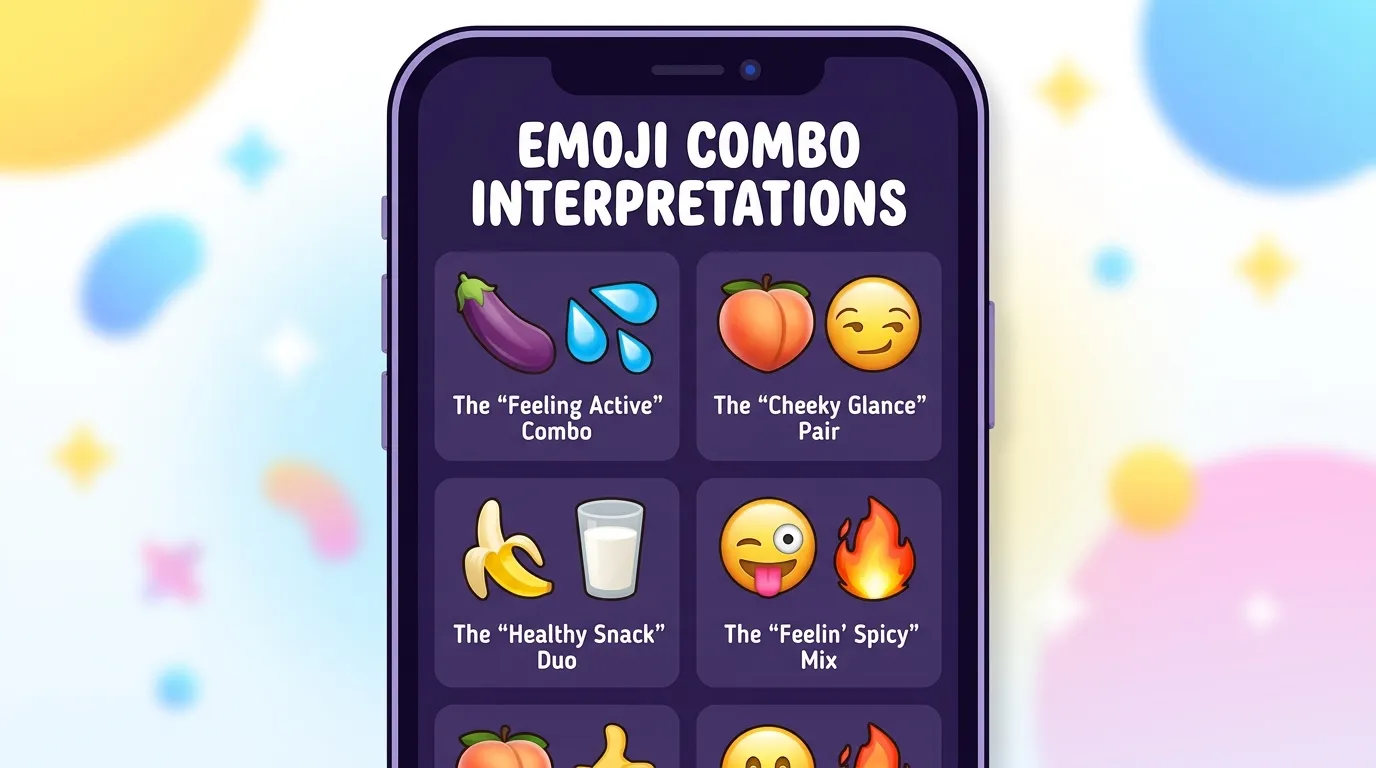
Some emoji combinations look harmless but can carry rude, offensive, or uncomfortable meanings in certain conversations.
Inappropriate emoji combos can refer to combinations that communicate insults, harassment, adult-coded ideas, or other meanings that may not fit a particular audience. Emoji meanings aren’t fixed: experts consider intended meaning, real-world usage, cultural context, and platform differences when interpreting them.
The safest way to interpret an unusual emoji combination is to look at the context before assuming what it means.
What Are Inappropriate Emoji Combos?
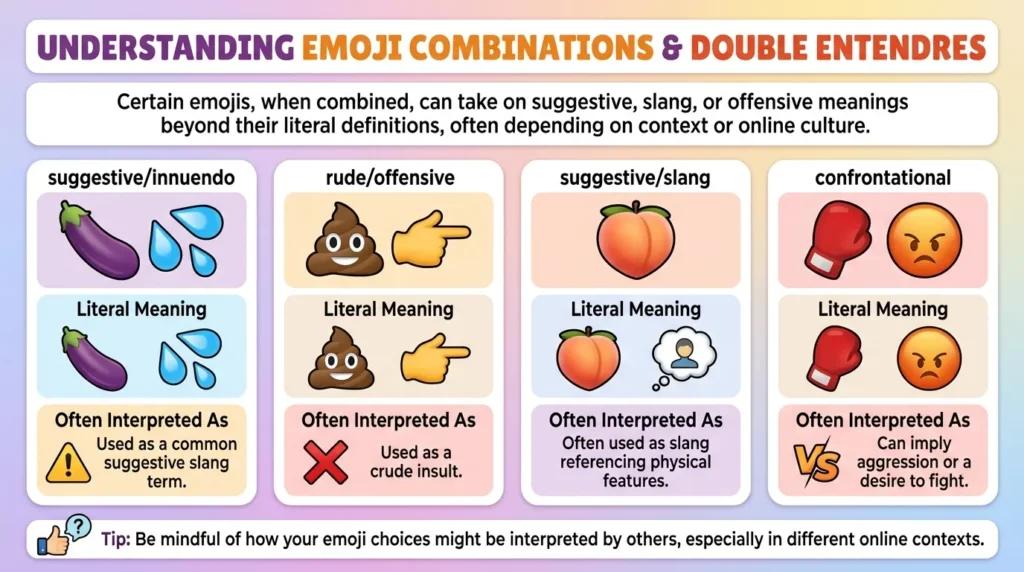
An inappropriate emoji combination is generally a group of emojis that may create a rude, offensive, suggestive, or otherwise unsuitable message. The same emoji can be completely harmless in one situation and uncomfortable in another.
For example, an emoji representing an animal, food, or hand gesture can have a different interpretation when paired with other symbols. Emojipedia notes that alternative meanings can develop through online communities, slang, and cultural use.
| Emoji type | Possible issue | Safer interpretation | Best approach |
|---|---|---|---|
| 😈 | Can sound overly suggestive | Mischievous or playful | Consider the audience |
| 🙄 | Can seem dismissive | Light frustration | Use with familiar people |
| 🤬 | Represents swearing | Strong frustration | Avoid in formal settings |
| 👌 | Meanings vary by culture | Agreement or “okay” | Consider regional context |
| 🐵 | Can become insulting in context | Animal-related use | Never use toward a person as an insult |
| 🚫 | Signals something is prohibited | Clear warning | Useful for boundaries |
😈 Smiling Face with Horns
Meaning: Often communicates mischief, cheekiness, or a playful attitude.
Example 1: I have a mischievous idea 😈
Example 2: You know I like causing harmless trouble 😈
🙄 Face with Rolling Eyes
Meaning: Disbelief, sarcasm, annoyance, or playful frustration.
Example 1: Not this again 🙄
Example 2: You really said that 🙄
🤬 Face with Symbols on Mouth
Meaning: Strong frustration or swearing.
Example 1: That was incredibly frustrating 🤬
Example 2: I can’t believe that happened 🤬
👌 OK Hand
Meaning: Agreement, approval, or “okay,” although its interpretation can vary by culture and context.
Example 1: Everything is okay 👌
Example 2: That works for me 👌
🐵 Monkey Face
Meaning: A monkey or playful animal reference, but context can make animal emojis insulting or harmful when directed at people.
Example 1: The monkey at the zoo was funny 🐵
Example 2: Look at this silly cartoon monkey 🐵
🚫 Prohibited
Meaning: Something is not permitted or should be avoided.
Example 1: No spoilers 🚫
Example 2: Keep personal information private 🚫
How to Interpret Inappropriate Emoji Combos
The first rule is context matters. An emoji that appears in a harmless conversation may have an entirely different interpretation when someone uses it as an insult or to target another person. Emojipedia specifically highlights context when explaining how emojis can acquire alternative meanings.
Next, consider the relationship between the sender and recipient. Close friends may use sarcasm that would seem rude between strangers. A message posted publicly can also affect more people than a private joke.
Culture matters too. Some gestures and symbols have different interpretations in different regions. For example, the OK hand 👌 has ordinary uses but has also acquired offensive interpretations in particular contexts and regions.
Do: Read the complete message before interpreting an emoji combination.
Do: Consider the audience and cultural setting.
Don’t: Assume every unusual combination has a hidden meaning.
Don’t: Use emojis to insult, harass, or embarrass another person.
Common Inappropriate Emoji Situations
Sarcasm
- 👉 🙄 — Can make a sarcastic response sound stronger.
- 👉 😏 — May add a smug or teasing tone.
- 👉 🤬 — Can emphasize strong frustration.
Arguments
- 👉 🙄🤬 — A visibly frustrated reaction.
- 👉 😒🙄 — An annoyed response.
- 👉 🚫 — A clear signal that something isn’t acceptable.
Online comments
- 👉 🙄 — Can appear dismissive toward another person’s post.
- 👉 🤬 — Can make criticism look aggressive.
- 👉 🚫 — Can be used to indicate disagreement or rejection.
Cultural misunderstandings
- 👉 👌 — Usually means “okay,” but context and location can affect interpretation.
- 👉 🐵 — Harmless for animals but inappropriate when used to demean a person.
- 👉 🚫 — Useful when you want to clearly communicate a boundary.
Safer communication
- 👉 👍 — Simple agreement.
- 👉 ❤️ — Friendly support or care.
- 👉 🙂 — A generally positive, approachable tone.
Trending Inappropriate Emoji Interpretations in 2026
Emoji meanings continue to evolve as online communities create new slang, jokes, and alternative uses. Some interpretations become popular within specific communities without becoming universal meanings. Emojipedia has noted that repurposed emojis can spread through platforms and communities, sometimes creating confusion for people unfamiliar with the original context.
For this reason, it is better to treat unusual meanings as context-dependent rather than assuming an emoji always carries the same message.
| Emoji | Context to watch | Why interpretation varies | Safer approach |
| 😈 | Teasing or jokes | Tone can be unclear | Add words for clarity |
| 🙄 | Sarcasm | May seem dismissive | Use carefully |
| 🤬 | Arguments | Strong emotional tone | Avoid personal attacks |
| 👌 | Different cultures | Gesture meanings vary | Consider your audience |
Emoji language keeps changing as communities adapt familiar symbols for humor, slang, and new forms of online expression.
FAQ
1. What makes an emoji combo inappropriate?
Context usually determines whether a combination is inappropriate. It may become unsuitable because it is insulting, aggressive, culturally offensive, or simply inappropriate for the audience.
2. Does every unusual emoji combination have a hidden meaning?
No. Many combinations are simply creative or humorous. Avoid assuming that an unfamiliar combination automatically represents a secret message.
3. Can emoji meanings differ between countries?
Yes. Gestures and symbols can have different cultural associations. The OK hand 👌 is one example where regional context can affect interpretation.
4. What should I do if someone sends an uncomfortable emoji combination?
If you aren’t sure what it means, don’t assume. You can ask what they meant, ignore it, or tell the person that the message made you uncomfortable.
Understanding inappropriate emoji combos is mostly about context, audience, and respect.
A symbol that seems harmless by itself can sometimes communicate something very different when combined with other emojis or directed at a particular person.
When you’re unsure, choosing clear and respectful emojis is usually the easiest way to avoid misunderstandings.